
The enrollment cliff is no longer a distant concern for colleges and universities. The number of traditional college-age students has peaked, and the decline that follows is already changing the enrollment landscape.
Institutions are looking at new geographic markets, transfer students, adult learners, returning students, dual-enrollment students, and other populations.
That creates a bigger question for enrollment teams: Can your recruitment strategy change as quickly as the market does?
The Traditional Recruitment Model Is Changing
For decades, many higher education institutions built recruitment programs around a relatively familiar audience: traditional-age students graduating from high school and entering college soon afterward.
But that audience is shrinking, and many institutions can no longer rely on it as their primary source of enrollment growth.
Adult learners illustrate the challenge. First-time enrollment among students over 25 fell 15.5% from fall 2024 to fall 2025, even as institutions increasingly look to adult learners to offset declines among traditional-age students [1].
A changing recruitment strategy affects much more than a marketing message. It requires changes to:
- Communications and outreach
- Recruitment events and activities
- Follow-up schedules
- Forms and information collected
- Student segmentation
- Pipeline reporting
This is where recruitment technology matters. As we discussed in Student Recruitment Software: What Colleges & Universities Should Look For, recruitment software needs to support the processes enrollment teams actually use.
Recruitment Strategies Need to Change Quickly
Enrollment teams are already adjusting their tactics in response to changing conditions.
For example, only 61% of surveyed enrollment leaders expected to meet their fall 2026 enrollment goals [2].
Among the strategies institutions identified as important were:
- Faster and clearer financial aid offers
- Parent engagement
- Campus visits
Those strategies require different audiences, communications, activities, follow-up, and measurements.
The same is true when an institution expands into a new geographic market or develops a new transfer or adult learner program. The recruitment process has to change with the strategy.
Your CRM Should Not Become the Limiting Factor
A CRM should make those changes easier, not harder.
A new recruitment program requires a different workflow. A new student population needs different communications. A new partnership requires different forms or tracking. A new enrollment goal requires different reports.
If making those changes requires spreadsheets, manual work, duplicate data entry, or complicated workarounds, the CRM starts limiting the recruitment strategy instead of supporting it.
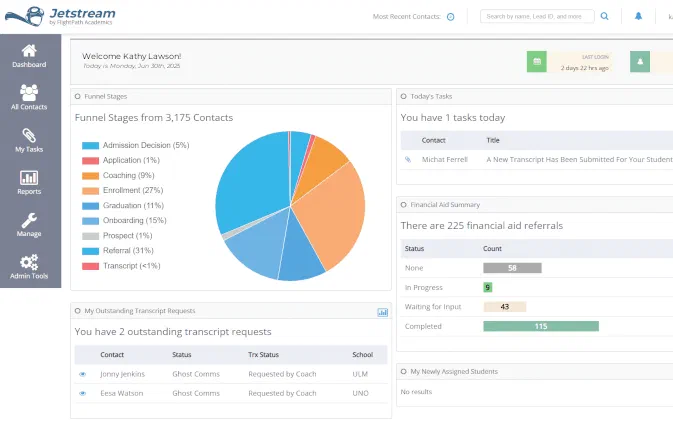
This is one of the reasons we built Jetstream differently. Jetstream is designed around the way an institution recruits students, rather than requiring the institution to redesign its recruitment process around the CRM.
A student recruitment CRM should give enrollment teams a central place to manage prospects, recruitment activities, communications, and the enrollment pipeline while adapting to the way the institution operates.
Data Matters When Recruitment Gets More Competitive
Changing recruitment strategies also makes it more important to understand what is happening across the enrollment pipeline.
Enrollment teams need to know:
- Which recruitment activities generate interest?
- Which communications lead to applications?
- Where do prospective students stop engaging?
- Which populations respond to particular outreach efforts?
- Which recruitment sources are producing results?
When recruitment information is scattered across separate systems and spreadsheets, those questions become harder to answer.
Connecting recruitment data gives enrollment teams a clearer picture of what is working and where they need to focus their efforts. CRM data can also help institutions identify opportunities to improve enrollment yield by connecting activity across the recruitment process.
Flexibility Matters
There is no single recruitment strategy that will work for every institution or every enrollment cycle.
As higher education institutions pursue new markets and student populations, their recruitment technology needs to keep up. When the recruitment strategy changes, the technology supporting it should be ready to change too.
Learn more about Jetstream’s features.